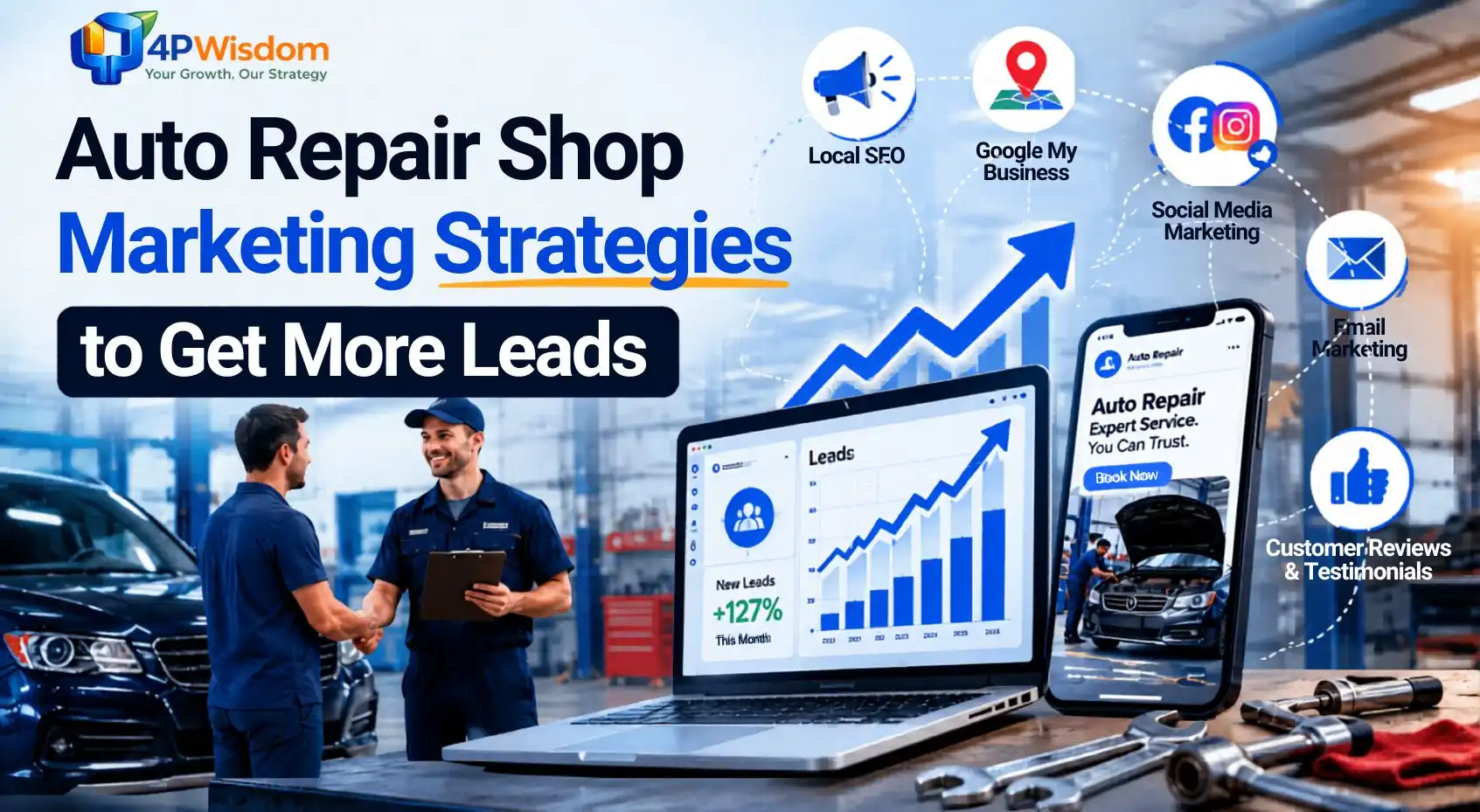
I have worked with over 100 independent auto repair shops across the country. The story is almost always the same. Great mechanics. Loyal regulars. But the phone stops ringing when you need it most. The shops that consistently fill their bays don’t have the biggest budgets. They have the smartest systems. This guide covers every strategy that actually works for auto repair shops in 2026. We go deep on local SEO, Google reviews, paid ads, social media, and customer retention. Every strategy has real examples and exact steps you can follow starting today.
First of all, let me tell you some stats. 97% of customers look online before selecting a local service provider, showing how important digital presence has become. Around 46% of all Google searches are driven by local intent, highlighting nearby needs. Additionally, 88% of people trust online reviews just as much as recommendations from friends, making reputation crucial for businesses today.
4P Wisdom offers auto repair shop marketing that helps local repair businesses get more calls, bookings, and loyal customers. We use simple but effective digital marketing strategies like SEO, Google Ads, and social media to grow your online presence. Our clients have seen up to 60% more bookings and 45% more customer inquiries with better local visibility.
Local SEO: The Foundation of Everything
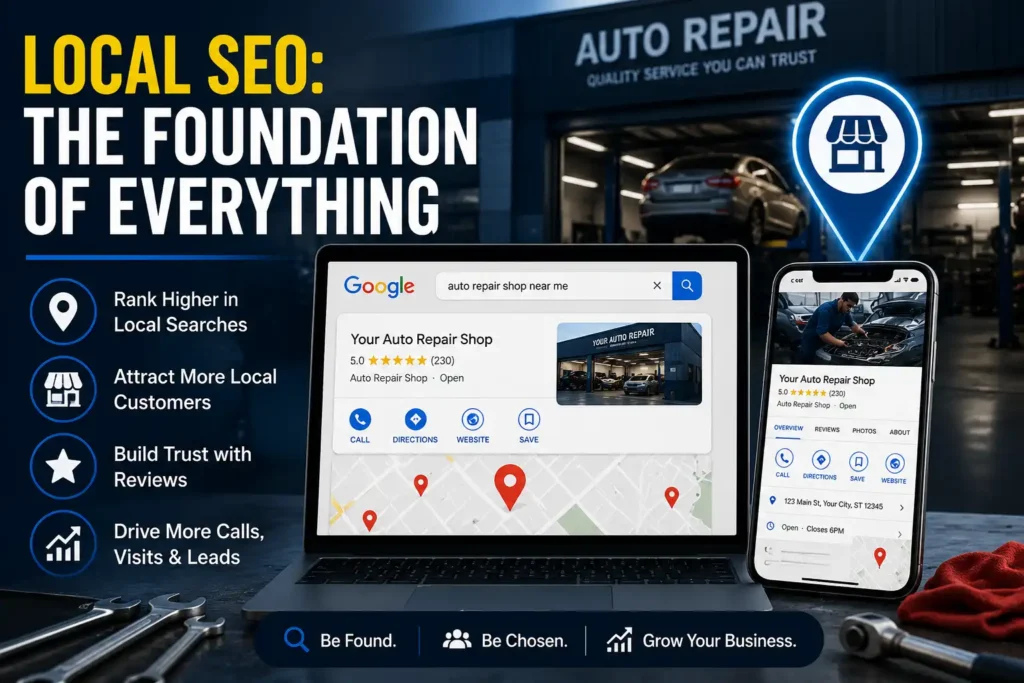
If people in your city can’t find your shop online, nothing else matters. Local SEO is the single highest-ROI marketing channel for auto repair shops.
Dominate Google Business Profile
Your Google Business Profile (GBP) is the most important marketing asset your shop has. It shows up in Google Maps and the local three-pack. It appears before your website in many searches.
Most shop owners set it up once and forget about it. That is a serious mistake. Google rewards profiles that are actively maintained and regularly updated. Think of it like a social media profile. The more you put in, the more you get out.
Complete Every Section Without Exception
Start with the basics. Make sure your business name, address, and phone number are accurate. These must match exactly what is on your website and everywhere else online. Even small differences in formatting can hurt your local rankings.
Add your correct business category. “Auto Repair Shop” should be your primary category. Then add secondary categories like “Oil Change Service,” “Brake Shop,” and “Transmission Shop.” The more specific your categories, the more searches you appear in.
Write a compelling business description. Mention your city and neighbourhood. Include your key services like oil changes, brakes, transmission, and AC repair. Google reads this description carefully. It influences which searches show your profile.
Upload Fresh Photos Every Week
Profiles with photos get far more clicks than those without. But it is not just about having photos. It is about having new, recent photos. Google’s algorithm favours profiles that add content regularly.
Take photos of your bays and equipment. Show your team at work on vehicles. Photograph before-and-after repairs when the vehicle looks dramatically different. Share photos of your waiting area and front desk. These photos build trust before a customer ever calls.
According to Google, businesses with photos receive 42% more requests for directions. They also get 35% more website clicks. That is a huge difference for almost zero cost.
Post Updates at Least Twice Per Week
Google Posts are a free feature that almost nobody uses. You can post specials, seasonal promotions, and service reminders. Posts appear directly on your Google Business Profile.
Post a “Spring AC Check Special” before summer arrives. Post a “Winter Tire Swap” offer before the cold hits. Post a “Free Battery Check” in November when batteries start failing. These posts cost nothing. They make real calls.
Enable and Monitor Messaging
Turn on the messaging feature in your Google Business Profile. Many customers prefer texting over calling. A quick response to a message can convert a browser into a booking within minutes.
Pro Tip
Add your services individually in the Services section of GBP. Each service you add becomes a keyword Google can match to searches. A shop with 25 individual services listed ranks for far more searches than one with just a general description. I have seen this alone increase phone calls by 30% within 60 days.
Target the Right Local Keywords
Keyword research for auto repair shops is different from other industries. Most of your customers search with their city name. They search for the service they need right now. Your job is to be the first result they see.
Service Plus Location Keywords
The most valuable keywords follow a simple pattern. They combine a service type with a location. These are called geo-modified keywords. Examples include:
- “Oil change in [city name]”
- “Brake repair near [neighbourhood]”
- “Transmission service [city]”
- “Check engine light [city]”
- “AC repair shop near me”
- “Best auto repair shop in [city]”
Use a free tool like Google’s Keyword Planner to find the exact phrases people search in your city. You can also use Semrush orAhrefs for deeper research.
Emergency and Urgent Keywords
Some of your highest-value customers are in distress. Their check engine light just came on. Their brakes are grinding. These customers call the first shop they can find quickly. Targeting urgent keywords captures high-intent customers. Phrases like “emergency auto repair near me” and “same-day brake repair” convert extremely well.
Seasonal Keywords Matter Too
People search for car-related services at predictable times of year. Create content and campaigns around these patterns. Target “car battery replacement” searches more aggressively in autumn. Push “AC service” in late spring. Promote “winter tyre changeover” in early October. Aligning your marketing with seasonal search behaviour drives more leads at a lower cost.
Build Consistent Local Citations
A local citation is any online mention of your shop’s name, address, and phone number. These appear on business directories, review sites, and local websites. Google uses citations to verify that your business is legitimate and well-established.
The keyword is consistent. Your business name, address, and phone number must be identical everywhere. If your website says “123 Main St” but Yelp says “123 Main Street,” Google sees these as potentially different businesses. That inconsistency weakens your local ranking.
Priority Directories for Auto Repair Shops
Make sure your shop is listed and accurate on all of these platforms:
- Yelp Business — one of the most-viewed directories for local services
- Yellow Pages — still drives traffic, especially from older demographics
- Better Business Bureau — important for trust signals
- Angie’s List (Angi) — strong for home and auto service searches
- Carfax Service Shop Directory — highly relevant for auto shops specifically
- RepairPal — a trusted resource customers use to find verified shops
- Apple Maps Connect — don’t forget iPhone users
- Bing Places for Business — still 8% of search market share
Time-Saving Tool for Citations
Managing citations manually across 50-plus directories is painful. Tools like BrightLocal and Yext automate citation building and management. For most small shops, BrightLocal’s monthly plan at around $29 per month is worth every penny.
On-Page Local SEO for Your Website
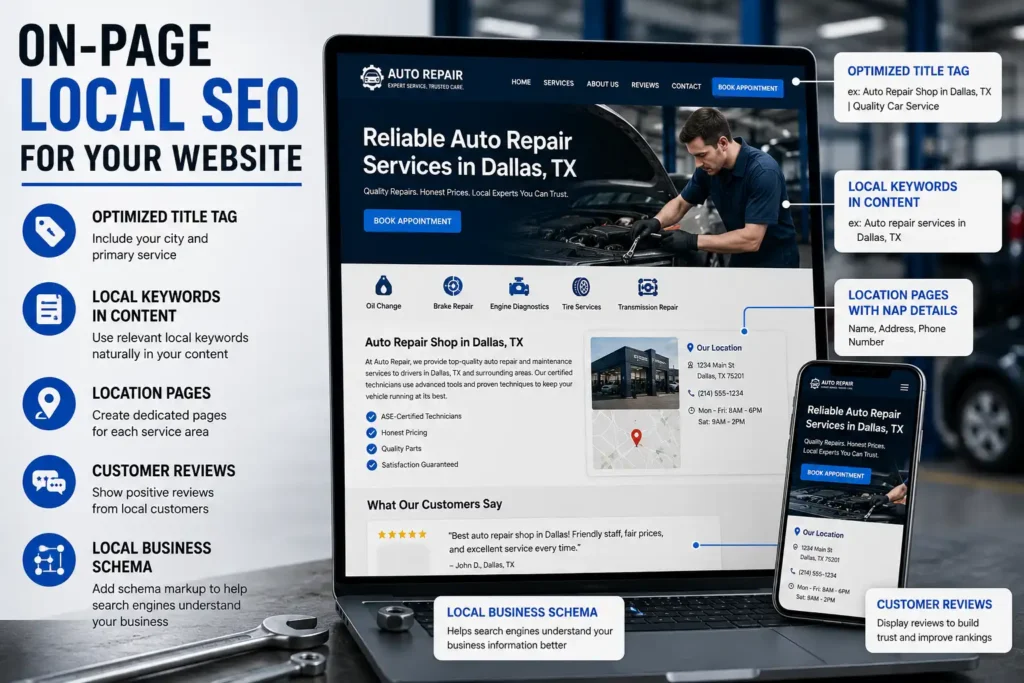
Your website needs to tell Google exactly who you are, where you are, and what you do. This is called on-page local SEO. Done right, it significantly boosts your rankings for local searches.
Include Your City in Key Page Elements
Put your city name in your homepage title tag. Something like “Expert Auto Repair in [City Name] | [Your Shop Name]” is ideal. Also, include your city in your H1 heading. Add it naturally in the first paragraph of your homepage text.
Your footer should show your full address on every single page. This is called your NAP footer. It confirms your location to both Google and users.
Add Schema Markup for Local Business
Schema markup is code that tells search engines specific details about your business. Schema.org has a specific type for Auto Repair businesses. Adding this structured data helps Google display rich information about your shop in search results. It can show your hours, phone number, and star rating directly in the results.
If you use WordPress, plugins like Rank Math and Yoast SEO make adding schema markup easy. No coding required.
Create Individual Service Pages
Do not put all your services on one page. Each major service should have its own dedicated page. Create separate pages for oil changes, brake repair, transmission service, AC repair, engine diagnostics, and tyre services.
Each page should be at least 500 words. It should target a specific keyword like “Brake Repair in [City].” This approach gives Google much more content to index. It dramatically increases the number of relevant searches where your website appears.
Online Reviews: Your Digital Word-of-Mouth
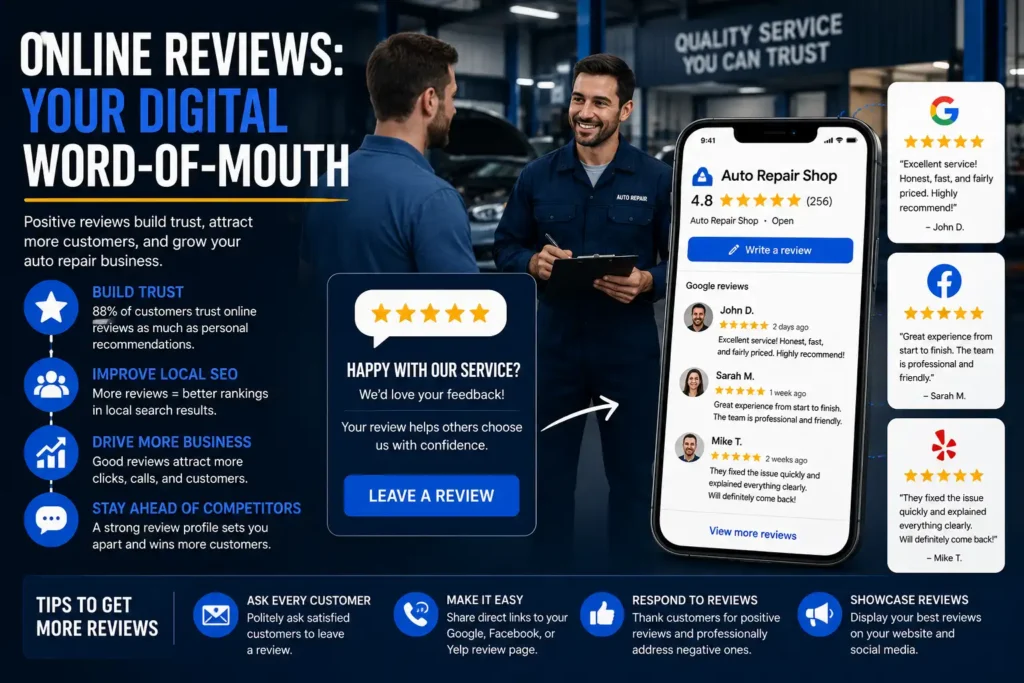
Reviews are the number one factor that influences whether someone chooses your shop over a competitor. A steady stream of recent, positive reviews is non-negotiable in 2026.
How to Get a Constant Flow of Reviews
Most shop owners know reviews matter. Very few have a system that consistently generates them. The difference between a 3.8-star shop and a 4.8-star shop is almost always a system, not a luck problem.
The best time to ask for a review is at the exact moment a customer is happiest. That moment is when they pick up their vehicle. The repair is done. The problem is solved. They feel relieved. That is when you ask.
Build an Automated Review Request System
Manual review requests are inconsistent. Some service advisors remember to ask. Others don’t. An automated system sends a review request every single time without fail. Here is how to set it up:
Step 1: Collect Customer Phone Numbers and Emails
Make sure you capture every customer’s mobile number and email address at check-in. You need this for the follow-up system to work. Most shop management software, like Shopmonkey or Tekmetric, does this automatically.
Step 2: Send a Text Message Within 2 Hours of Pickup
Research shows that review request messages sent within two hours of service completion get the highest response rates. Send a simple, friendly text that thanks them and includes a direct link to your Google review page.
Step 3 : Keep the Message Short and Personal
Something like: “Hi [Name], thanks for trusting [Shop Name] with your vehicle today. We would love to hear about your experience. It takes just 60 seconds: [direct review link]” This converts far better than a formal template.
Step 4: Send One Follow-Up Email If No Response
Three days after the service, send one follow-up email. Mention a specific detail about their car if possible. Personalisation dramatically improves response rates on follow-ups.
Your goal should be getting at least 10 new Google reviews per month. This keeps your profile fresh in Google’s eyes. It signals active business operations. And it continuously builds trust with new potential customers who see recent, real reviews. Shops I have worked with that hit this goal consistently rank in the top 3 map results within 90 days.
Never Offer Incentives for Reviews
Do not offer discounts, freebies, or any reward for leaving a review. Google’s review policies strictly prohibit this. Violating this policy can result in your Business Profile being suspended entirely. It is not worth the risk. Ask genuinely. People respond to that.
How to Respond to Reviews the Right Way
Responding to reviews is as important as getting them. Google considers your response rate and response speed as local ranking factors. Potential customers read your responses just as carefully as they read the reviews themselves.
Responding to Positive Reviews
Thank the customer by name. Mention the specific service they had done. Invite them back. This shows you actually read reviews and genuinely care. It also helps your SEO because your response text contains relevant keywords.
For example: “Thanks so much for the kind words, Sarah! We are glad the brake service went smoothly. Looking forward to seeing you for your next oil change! That response naturally includes keywords like “brake service” and “oil change”.
Responding to Negative Reviews
Never argue with a negative review. Never post defensively. A bad response to a negative review can damage your reputation more than the original review did.
Instead, acknowledge the issue. Apologies for the experience. Offer to make it right offline. Something like: “We are sorry to hear this did not meet your expectations. Please call us at [number] so we can make this right.” This response shows potential customers you are professional and responsive.
Warning: Never Do This
Do not offer a refund or compensation publicly in a review response. This signals to dishonest people that leaving negative reviews results in free money. Always move resolution conversations to a private channel. One or two resolved complaints handled professionally can actually increase trust with future customers who see how you handle problems.
Diversify Your Review Platforms
Google reviews are the most important. But do not neglect other platforms. Yelp reviews influence rankings on Apple Maps. RepairPal reviews specifically target automotive customers. Facebook reviews matter for social proof when running ads. Aim to build reviews on at least three platforms simultaneously.
Google Ads: Fill Your Bays Immediately
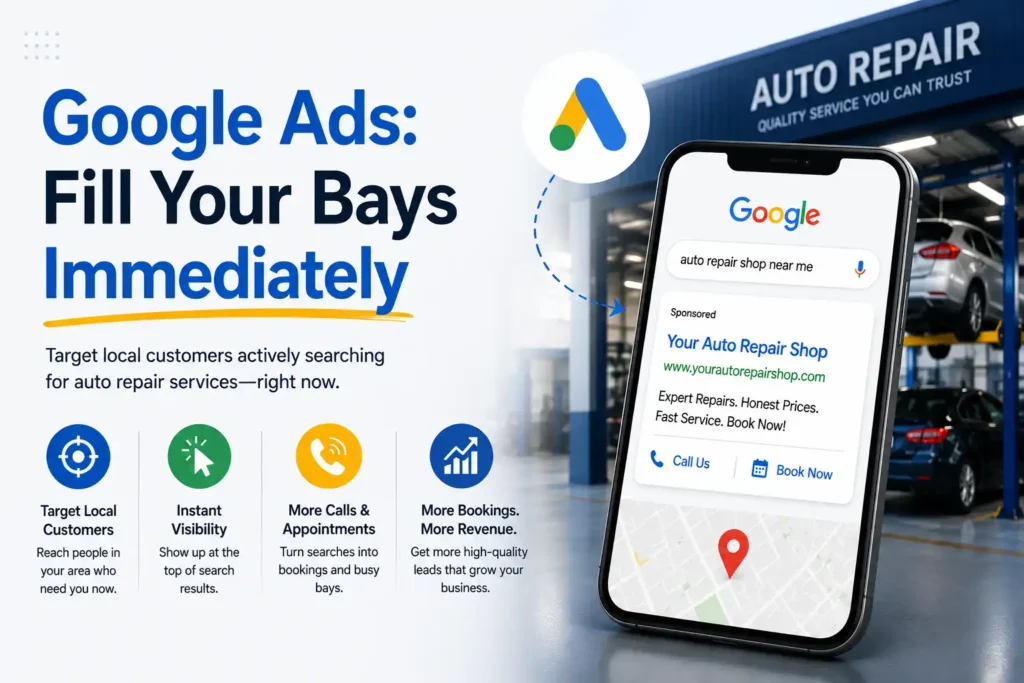
Performance marketing through Google Ads is one of the fastest ways to generate quality leads for your auto repair shop. With the right setup and targeting, your business can start showing at the top of search results within days, helping you attract more local customers and increase bookings quickly.
Start with Google Local Service Ads
Google Local Service Ads (LSA) appear above regular paid search ads. They show your business name, star rating, and a call button. You only pay when a customer calls or messages directly through the ad. This is called pay-per-lead rather than pay-per-click.
For auto repair shops, LSA typically delivers a much lower cost per lead than standard Google Ads. I have seen shops get qualified calls for $15 to $30 each through LSA. The same calls from standard Google Ads often cost $50 to $80 each.
Getting the Google Guarantee Badge
To run LSA, you need to pass Google’s verification process. This involves a background check for your business and potentially your technicians. You also need to provide proof of insurance and a licence. Getting the Google Guarantee badge adds a green tick to your ad. This dramatically increases customer trust and conversion rates.
How to Maximise Your LSA Performance
- Make sure your GBP has at least 25 reviews before running LSA
- Respond to every lead within 5 minutes — Google tracks your response time
- Mark leads as “booked” promptly inside the LSA dashboard
- Dispute invalid leads immediately to avoid paying for them
- Keep your availability calendar updated accurately
LSA Ranking Factors Google ranks your LSA based on review count, review score, response rate, and proximity. Shops with more reviews and faster response times appear first. This is why building your review system first is so important. A shop with 80 reviews will always outperform a shop with 20 reviews in the LSA results, regardless of budget.
Running Profitable Google Search Campaigns
Standard Google Search Ads give you more control over targeting and messaging. They work well for specific high-value services where the average repair ticket is large enough to justify the cost per click.
Target High-Value Service Keywords
Not all repairs are worth advertising equally. Focus your ad budget on services with high average repair values. Transmission repair, engine repair, timing belt replacement, and AC system service all have high ticket values. A $65 click that converts to a $1,200 repair is excellent ROI. A $40 click for an oil change that nets $45 is terrible ROI.
Target keywords that signal high intent. Phrases like “transmission repair near me,” “check engine light diagnosis [city],” and “AC not blowing cold [city]” indicate someone needs repair now. They are not just browsing.
Use Location Targeting Precisely
Do not target your entire state or region. Target a realistic radius around your shop. Most customers will not drive more than 10 to 15 miles for routine repairs. For major repairs, they might travel further. Set your radius accordingly and avoid paying for clicks from people who will never visit.
Build Dedicated Landing Pages
Sending ad traffic to your homepage is one of the biggest mistakes in auto repair advertising. Create a dedicated landing page for each ad campaign. A transmission repair ad should go to a transmission repair landing page. It should have your phone number prominently displayed, a simple contact form, and clear trust signals like reviews and certifications.
A well-designed landing page can double or triple your conversion rate from the same ad spend. That means twice as many leads for the same budget.
Set Up Conversion Tracking First
Before spending a single dollar on Google Ads, set up proper conversion tracking. Install Google Analytics 4 on your website. Track phone calls from ads using Google Ads call tracking. Track form submissions. Without this data, you are flying blind. You cannot improve what you cannot measure.
Negative Keywords Are Not Optional
Add an extensive negative keyword list before your campaigns go live. Negative keywords prevent your ads from showing for irrelevant searches. Exclude terms like “auto repair manual,” “auto repair training,” “free auto repair,” “auto repair jobs,” and “DIY car repair.” Failing to do this wastes 20 to 40% of your budget on people who will never call your shop.
Budget Recommendation
For most independent auto repair shops, a starting budget of $800 to $1,500 per month for Google Ads is realistic. This is enough to run meaningful campaigns without overextending. Once you have conversion data showing profitability, scale up. I have worked with shops spending $5,000 per month on Google Ads profitably. But they started at $1,000 and proved the model first.
Your Website: The Hub of All Marketing
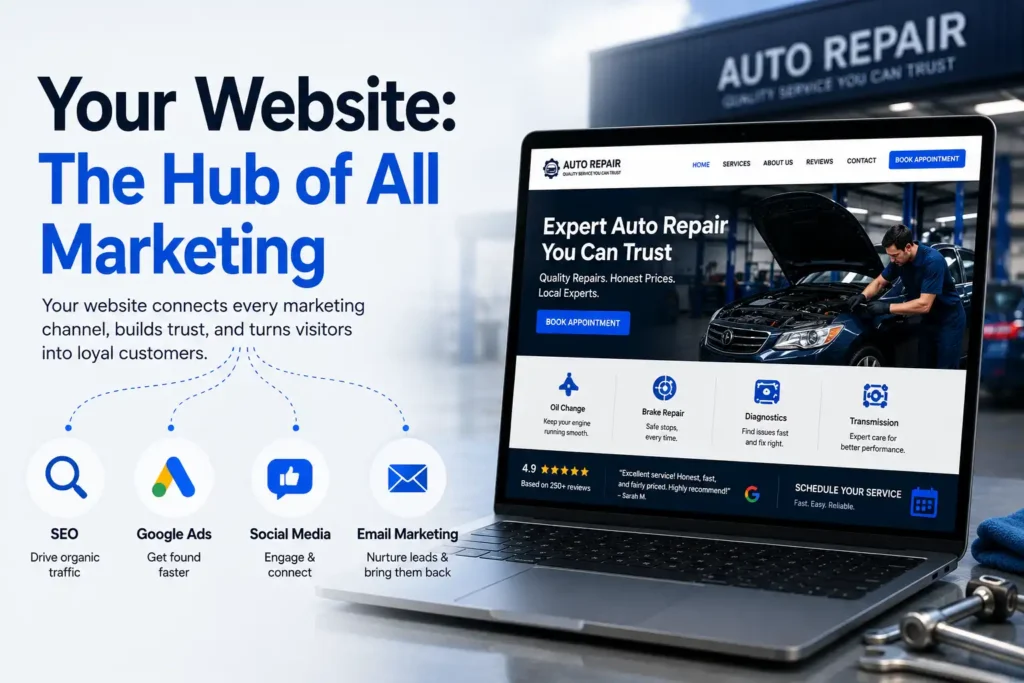
Every marketing channel leads potential customers to your website, which is why responsive website design is so important. If your site is slow, hard to navigate, or looks unprofessional on mobile devices, people will leave before booking. A fast, user-friendly website helps turn visitors into real customers.
Website Design and Speed Fundamentals
The auto repair customer looking for help right now has no patience for a slow or confusing website. They will bounce within seconds and call the next shop on the list. Your website has one job. Make it effortless for someone to trust you and contact you.
Speed is a Make-or-Break Factor
Check your website’s speed right now using Google PageSpeed Insights. If your mobile score is below 70, you are losing customers and rankings simultaneously. Page speed is a confirmed Google Core Web Vitals ranking factor.
The most common speed killers for auto repair websites are unoptimized images, too many plugins, and cheap shared hosting. Compress all images before uploading them. Use a fast hosting provider. Consider a CDN (Content Delivery Network) to serve your site faster to local visitors.
Mobile-First Design Is Non-Negotiable
Over 70% of auto repair searches happen on mobile devices. Someone’s car breaks down. They pull out their phone. They search for a nearby shop. If your website is hard to navigate on a phone, they are gone.
Make your phone number a clickable tap-to-call button. Put it at the very top of every page. Do not make mobile visitors scroll to find how to contact you. That single change has increased calls by 25% or more for shops I have worked with.
What Your Homepage Must Include
- Your phone number in large, clickable format at the top
- Your city and neighbourhood are mentioned in the first heading
- A clear list of your most common services
- Your Google star rating with a link to your reviews
- Photos of your shop, team, and equipment
- ASE certifications or other trust badges
- Your hours and address are in the footer of every page
An SSL Certificate Is Essential. Make sure your website uses HTTPS, not HTTP. An SSL certificate is required by Google for good rankings. It also shows the padlock icon in browsers. Without it, some browsers warn users that your site is “not secure.” That warning destroys conversion rates.
Service-Specific Landing Pages That Convert
Each of your major services should have its own dedicated webpage. Not just a line on a services list page. A proper, comprehensive page targeting a specific service and location.
A good service page for “Brake Repair in Houston” should include what brake repair involves, how long it takes, what it costs (at least a range), why choosing a certified shop matters, your specific brake repair process, customer testimonials mentioning brake work, and a clear call to action with your phone number.
The Services That Deserve Their Own Pages
- Oil change and fluid services
- Brake inspection and repair
- Transmission service and repair
- Engine diagnostics and repair
- AC service and repair
- Tyre services and rotation
- Battery testing and replacement
- Suspension and alignment
- Pre-purchase vehicle inspections
- Electrical system diagnostics
Each page should be at least 600 to 800 words. Use your target keyword naturally throughout. Include your city name in the page title, H1, and body text. Add a FAQ section answering common questions about that specific service. FAQs help your page rank for question-based searches.
Online Booking Is No Longer Optional
A significant percentage of modern car owners prefer booking appointments online. They do not want to call during business hours. They want to book at 9 PM after putting the kids to bed. If you do not offer online booking, you are losing those customers to shops that do.
Online booking tools also reduce the workload on your service advisors. Every appointment booked online is one fewer phone call they need to handle. That frees them to focus on customers already in the shop.
What to Look for in a Booking Tool
- It integrates with your existing shop management software
- It allows customers to select specific services
- It sends automatic confirmation texts and emails
- It sends reminder messages before the appointment
- It appears on your Google Business Profile as a booking option
Tools like Shopmonkey and Tekmetric all offer online booking features designed specifically for auto repair shops.
Real Impact of Online Booking:
One of my clients added online booking to their site on a Thursday evening. By the following Monday, they had three new appointments booked outside of business hours. All three customers specifically mentioned they booked because the process was easy. One of those customers became their highest-spending regular in the following year.
Social Media That Actually Builds Your Business
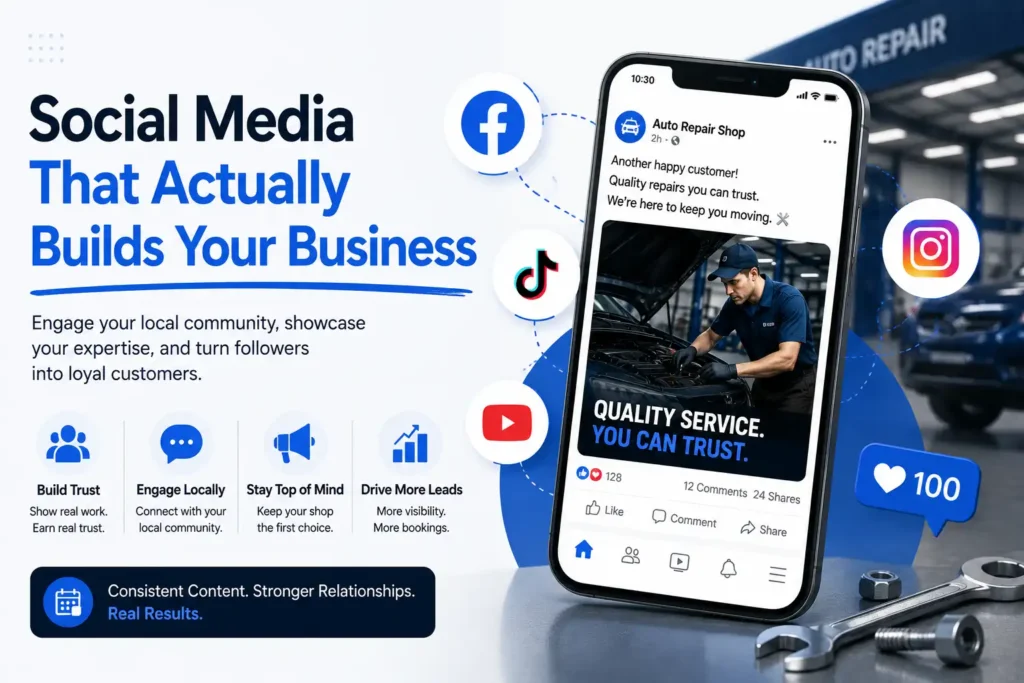
Social media marketing for auto repair shops is not about going viral or chasing trends. It’s about staying active, building trust, and keeping your shop visible in the local community.
Facebook: Your Community Hub
Facebook remains the most powerful social platform for local service businesses. Its age demographics lean slightly older, which aligns perfectly with the typical auto repair customer. Facebook also has the most powerful local targeting available for paid advertising.
What to Post on Your Facebook Page
- Before and after photos of interesting repairs
- Short videos explaining common car problems in plain language
- Seasonal maintenance tips with your shop branding
- Team spotlights, introducing your mechanics
- Customer testimonials with the customer’s permission
- Special offers and promotions with clear expiry dates
- Community involvement posts, like sponsoring local sports teams
Facebook Ads for Auto Repair Shops
Facebook Ads are especially powerful for re-engaging past customers and reaching new people nearby who have never heard of your shop. The targeting capabilities are remarkable. You can target people within five miles of your shop. You can target people who recently bought a vehicle. You can target by age, income range, and interests.
The most effective Facebook ad format for auto repair shops is the “seasonal reminder” ad. Run an ad in October saying “Is your car winter-ready?” with a simple coupon for a free inspection. Target people within 10 miles. A $200 Facebook Ad campaign like this typically generates $1,500 to $3,000 in repair revenue in my experience.
Retargeting Website Visitors
Install the Facebook Pixel on your website. This allows you to run ads specifically targeting people who have already visited your website. These are warm prospects who already know your shop exists. Retargeting ads typically convert at three to five times the rate of cold audience ads.
Instagram and Video Content That Gets Attention
Instagram and short-form video are increasingly powerful for auto repair shops. The audience tends to be younger, but that matters. You want to capture future loyal customers before your competitors do.
The Types of Content That Work for Auto Shops
Before and after photos perform exceptionally well. A heavily dented car next to the same car after panel beating and repainting is visually striking. These posts get high engagement and shares.
Short explanation videos build trust fast. Film a 60-second video of a mechanic explaining why brake fluid needs to be changed. Show the old fluid next to the new fluid. These educational videos position your shop as the experts and are immensely shareable.
Satisfying process videos are great for Instagram Reels. A time-lapse of a full engine removal and reinstall. Close-up shots of a brake job being done precisely. These appeal to the large online community of car enthusiasts and get far more reach than ordinary posts.
YouTube Shorts and TikTok for Younger Customers
Do not dismiss YouTube Shorts or TikTok for your shop. Shops that consistently post short, educational car care content build enormous local followings. The algorithm pushes this content to people in your geographic area.
Content Marketing: Build Trust at Scale
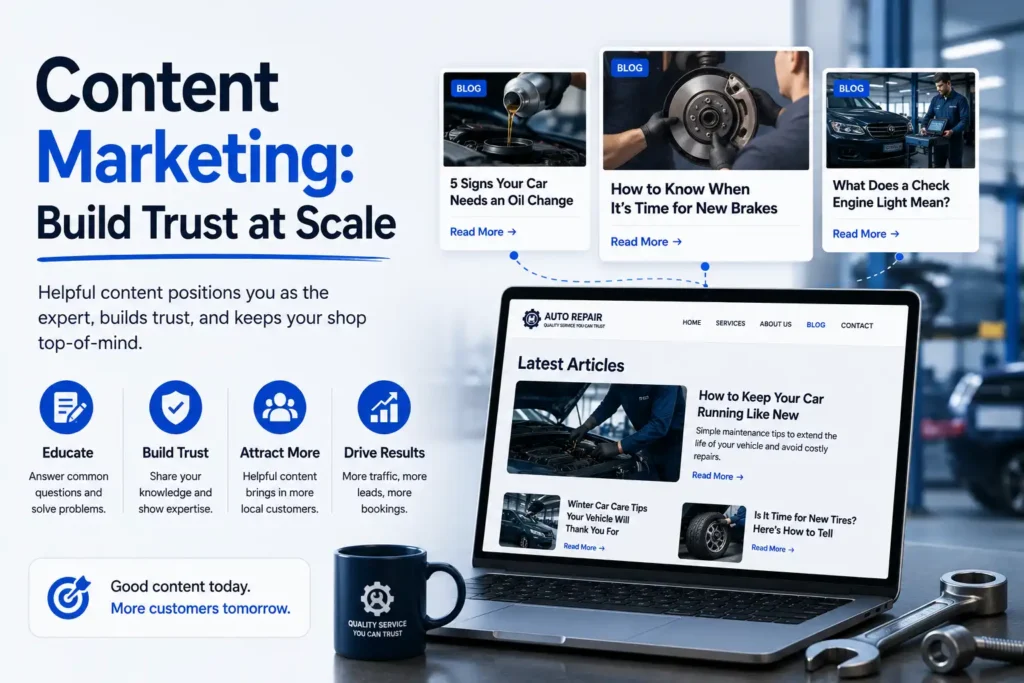
Content marketing earns you trust before a customer ever sets foot in your shop. The right content answers the questions your customers are already asking Google.
Blogging for Local SEO and Lead Generation
A blog might sound old-fashioned. But it is one of the most powerful SEO tools an auto repair shop can use. Every blog post is a new page that Google can rank. Every page that ranks is another way customers find your shop.
The Types of Blog Posts That Generate Leads
Problem-based posts capture customers in crisis. Titles like “What to Do When Your Check Engine Light Comes On in [City]” or “Why Is My Car Making a Grinding Noise When I Brake?” answer the exact question someone just typed into Google. These visitors are in the market for a repair right now.
Comparison posts help customers make decisions. “OEM vs Aftermarket Parts: What’s Better for Your Car?” or “Is It Worth Fixing a High-Mileage Car?” These posts build trust because you are providing genuinely useful information without a hard sell.
Seasonal maintenance posts are evergreen and highly searchable. “How to Prepare Your Car for Winter in [City]” gets searched every November. “Signs Your Car AC System Needs Service” gets searched every June. Write these posts once, and they generate leads every single season for years.
How Often Should You Post?
Aim for at least 4 to 6 posts per month. Consistency matters more than volume. A shop that publishes two solid 800-word posts per month will outperform one that posts 10 thin articles and then goes quiet for three months. Quality and consistency are everything in blog content.
Content Idea Generator: Go to AnswerThePublic.com and type in terms like “car repair,” “brake repair,” or “check engine light.” It will show you hundreds of actual questions people are searching for. Every question is a potential blog post. This free tool can give you a year’s worth of content ideas in 15 minutes.
YouTube as a Lead Generation Engine
YouTube is the second-largest search engine in the world. It is owned by Google. Videos that rank well on YouTube often also appear in Google search results. This makes YouTube an incredibly powerful SEO tool for local businesses.
You do not need high-quality production equipment. A modern smartphone in decent lighting is enough to create content that works. The quality of the information matters far more than production value for educational auto repair content.
Video Ideas That Drive Local Leads
- “What does [warning light] mean and what should you do?”
- “How do we diagnose a [common problem] at [Shop Name]?”
- “A tour of our shop in [City Name]”
- “What to expect during a full brake inspection”
- “How long does a transmission service take?”
- “5 things to check before buying a used car in [City]”
Optimise Your Videos for Local Search
Include your city name in every video title. Use keywords your customers search for. Add your shop’s full address and phone number in every video description. Link to your website in the first line of each description. Add location tags to every video. These steps help your videos appear when local customers search for auto repair help.
Customer Retention: Your Most Profitable Marketing
Getting a new customer costs five to seven times more than keeping an existing one. Your retention marketing is where your real profit lives. Most shops dramatically underinvest in this area.
Email and SMS Marketing That Brings Customers Back
Every customer who has ever visited your shop is a warm lead. They already know you. They already trust you to some degree. Getting them back for their next service should be far easier than finding a brand new customer.
Yet most auto repair shops have zero system for following up with past customers. They rely entirely on customers remembering to call when their car needs work. That is leaving enormous revenue on the table.
Service Reminder Emails Work Remarkably Well
Set up automated service reminder emails based on time since last visit or mileage. Someone who got an oil change at your shop six months ago probably needs another one. An automated email saying “Hey [Name], it has been about six months since your last oil change. Ready to book?” is simple and extremely effective.
SMS Beats Email for Urgency
Text message open rates average around 98%. Email open rates average around 21%. For time-sensitive service reminders, SMS almost always outperforms email. Twilio and Podium both offer affordable SMS marketing tools that integrate with most shop management systems.
What to Send and When
- Oil change reminder at 5,500 miles or five months after last service
- Tyre rotation reminder at six months after the last rotation
- Annual vehicle inspection reminder each year in the same month
- Seasonal promotions two weeks before the season starts
- Birthday discount for your most loyal customers
- Declined service follow-up after 30 and 60 days
Declined Services: Hidden Revenue. Every service your technicians recommended but the customer declined is a warm sales lead sitting in your database. Have your service advisors call customers one month after a declined service. A simple call saying “Hi, we recommended replacing your brake pads last month. How are they holding up?” converts surprisingly often. Many customers simply needed more time to make the decision.
Simple Loyalty Programs That Actually Work
A loyalty programme does not need to be complicated. The goal is simply to make your regular customers feel valued and to give them a reason to keep choosing your shop over the one down the street.
The Punch Card Model
The simplest loyalty programme for an auto shop is also one of the most effective. Offer a free oil change after every five paid oil changes. This is easy to understand, easy to manage, and genuinely drives repeat visits.
You can do this digitally using a simple app like Stampr or even just track it in your shop management system. The physical punch card also works fine. Some customers love having something tangible to carry in their glove box.
VIP Customer Club
For your top 20% of customers by revenue, consider a VIP programme. VIP members might get priority scheduling, a free annual inspection, and 10% off parts. The cost to you is minimal. The loyalty it creates is substantial. These are your advocates who refer friends and family to your shop.
The 80-20 Rule in Auto Repair. In most shops, around 20% of customers generate 80% of revenue. Know who those customers are. Treat them exceptionally well. A handwritten thank-you card from the owner after a major repair costs almost nothing. It creates a memory that the customer will tell their friends about. Word-of-mouth referrals from your VIP customers are often your highest-quality and lowest-cost new customer source.
Referral Programmes That Generate Consistent Leads
Your happy customers are your best salespeople. They already trust you. They have already recommended you to friends informally. A formal referral programme makes that process systematic and rewards both parties.
The simplest referral programme: give your existing customer a $25 credit for each new customer they refer. The new customer gets $25 off their first service. You pay $25 to acquire a new customer who could spend $1,000 per year with you for the next decade. That is an outstanding return on investment.
How to Promote Your Referral Programme
- Mention it verbally when customers pick up their vehicles
- Include it in your email follow-up sequence
- Post about it on social media once per month
- Add a card to the take-home bag with each service
- Put a small sign at your front counter
- Include it in your customer loyalty welcome message
The key to a referral programme is making it easy to share. Provide customers with a unique referral code or a simple share link they can text to friends. Friction kills referral programmes. The easier it is to refer, the more referrals you will get.
How to Allocate Your Marketing Budget
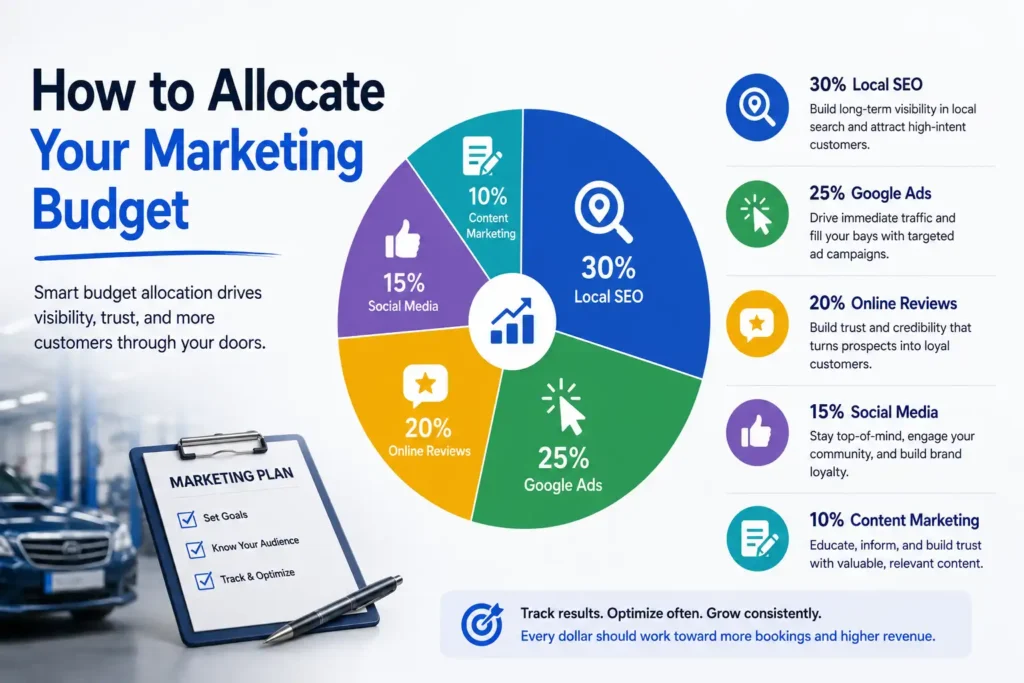
Marketing budget allocation depends entirely on your shop’s current situation. Here is a practical framework based on 15 years of working with independent auto repair shops.
Budget Frameworks for Different Shop Stages
I am going to be direct. Many shops waste marketing budget on the wrong channels at the wrong stage of their business. Here is what actually makes sense at each stage.
New Shop (Open Less Than 12 Months)
Your priority is generating leads fast while building long-term assets. Allocate your budget roughly like this: 40% on Google Ads and LSA for immediate leads, 30% on local SEO and website optimisation, 20% on social media content creation, and 10% on print and local community presence.
Your minimum viable marketing budget as a new shop is around $1,500 per month. Below this level, results will be frustratingly slow. If the budget is very tight, prioritise your Google Business Profile and review generation first. Both are free and provide the highest return per hour spent.
Growing Shop (1 to 3 Years Old)
By now, you have some data. You know which services are most profitable. You know where most of your customers come from. Shift your budget toward what is already working. Increase SEO investment as it begins to compound. Maintain Google Ads for your most profitable high-ticket services. Begin email and SMS marketing for customer retention.
Established Shop (3 Plus Years)
If your SEO is working well, organic leads should be your primary channel. Use paid ads selectively for seasonal promotions and high-value services where the cost per click is justified. Invest heavily in customer retention marketing. Returning customers are your most profitable segment.
The Rule of Thumb: Most marketing consultants recommend spending 5 to 10% of gross revenue on marketing for a growing business. A shop doing $600,000 per year in revenue should be spending $30,000 to $60,000 annually on marketing. That breaks down to $2,500 to $5,000 per month. If your shop is spending significantly less than this, you are likely under-investing in growth.
Leave a Reply